
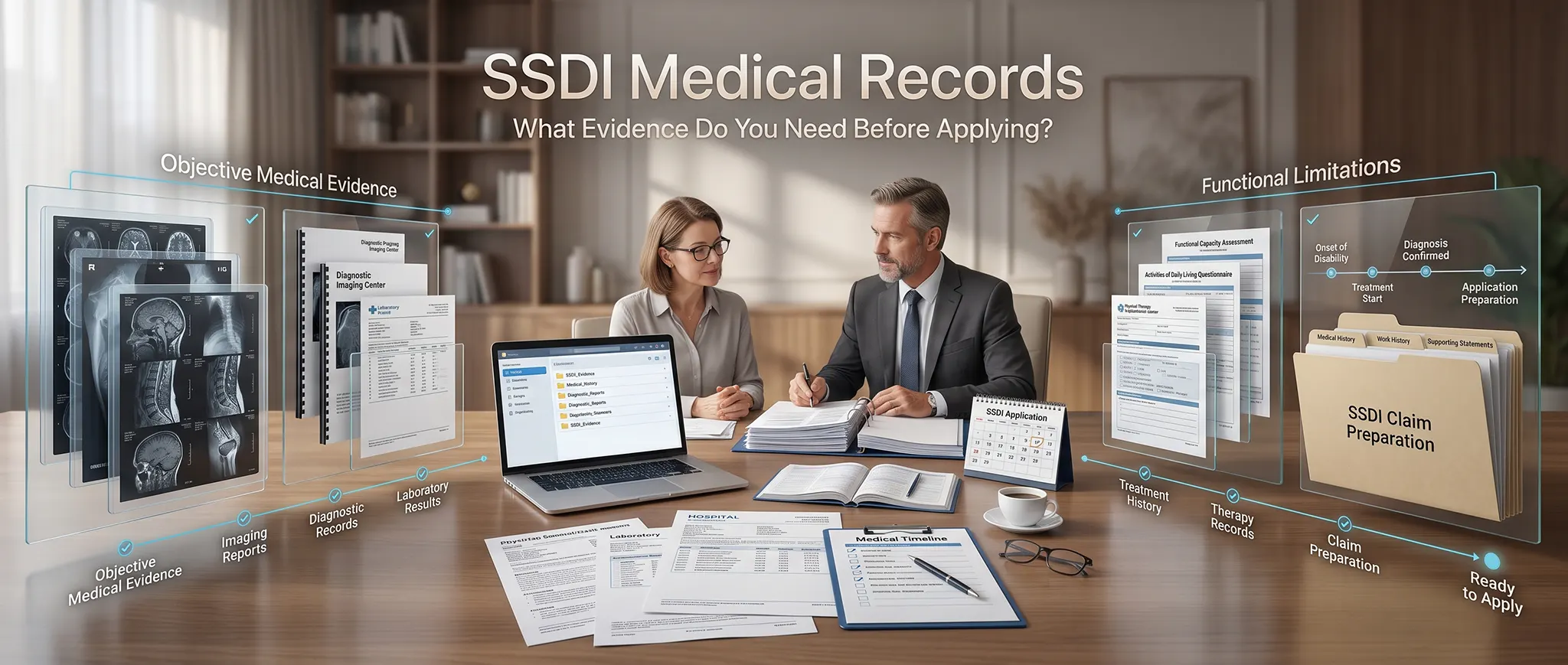
When a serious health condition limits your ability to work, the quality and completeness of your medical documentation can become central to a Social Security Disability Insurance claim. SSDI medical records help the Social Security Administration understand not only what conditions have been diagnosed, but also how those conditions affect your ability to function consistently in a work setting.
For applicants, the goal is not to collect every page of medical history without a plan. The more useful approach is to identify the medical evidence for SSDI that establishes a medically determinable impairment, documents treatment over time, and explains the practical limitations that prevent sustained work.
This guide explains what records may matter, how Social Security uses medical evidence, what gaps to look for before applying, and how to prepare a more organized disability claim.
Why Medical Documentation Matters in an SSDI Claim
Social Security evaluates disability using both medical and nonmedical information. On the medical side, the agency needs objective medical evidence from an acceptable medical source to establish that a medically determinable impairment exists. It then considers the broader record to assess severity, duration, symptoms, functional limitations, and the effect of the condition on work.
A diagnosis alone is not necessarily enough. People with the same diagnosis can have very different levels of functioning. Strong documentation should therefore help show what the person can still do and what can no longer be sustained reliably in a work setting.
What Types of SSDI Medical Records May Be Useful?
The most relevant records will depend on the condition, treatment history, and the limitations being claimed. Common examples include:
- Physician and specialist treatment notes
- Hospital and emergency-room records
- Imaging reports such as MRI, CT, or X-ray findings
- Laboratory and diagnostic test results
- Mental health treatment records
- Physical or occupational therapy notes
- Surgical and procedure reports
- Medication history and documented side effects
- Rehabilitation records
- Records from pain-management treatment
- Notes describing assistive devices or mobility limitations
- Clinical observations about concentration, memory, mood, or behavior
The purpose of SSDI medical records is not simply to prove treatment occurred. Ideally, they show the condition, treatment response, and limitations that remained.
Objective Medical Evidence: The Starting Point
Social Security generally requires objective medical evidence from an acceptable medical source to establish the existence of a medically determinable impairment. Objective evidence can include medical signs and laboratory findings.
Depending on the condition, this might include imaging showing structural abnormalities, pulmonary testing for respiratory disease, cardiac testing, neurological findings, laboratory studies, mental-status examinations, or other clinically documented findings.
Objective evidence establishes the medical foundation of the claim. However, the disability analysis usually goes further. Social Security may also consider symptoms, treatment response, medical opinions, daily functioning, and the combined effect of multiple impairments.
The Medical Record Should Explain Functional Limitations
One of the most important parts of medical evidence for SSDI is the connection between the medical condition and work-related functioning.
A record becomes more informative when it helps explain questions such as:
- How long can you sit before needing to change position?
- How long can you stand or walk?
- How much can you lift or carry?
- Can you use your hands repeatedly?
- Do you need unscheduled breaks?
- Does fatigue reduce your pace or stamina?
- Do pain or medication effects interfere with concentration?
- Can you understand and remember instructions?
- Can you interact appropriately with coworkers or the public?
- Can you maintain a predictable work schedule?
These functional details help transform a medical diagnosis into a clearer picture of occupational limitations.
Consistency Across Providers Can Strengthen the Record
Social Security reviews the evidence as a whole. Records from different providers can be more useful when they tell a reasonably consistent story about diagnosis, treatment, and functional limitations.
Significant inconsistencies may require explanation, so review the record for conflicting descriptions or missing context.
For example, treatment notes from a primary-care physician, specialist findings, imaging, and therapy records may collectively provide a more complete picture than one document considered alone.
Treatment History and Response Matter
A disability claim can span months or years, so the treatment timeline matters. Records should show what care was recommended, whether treatment was followed when reasonably possible, and what happened afterward.
Relevant information may include:
- Medication changes
- Surgery or other procedures
- Physical or occupational therapy
- Specialist referrals
- Hospitalizations
- Use of assistive devices
- Medication side effects
- Treatment that provided only temporary relief
- Conditions that continued despite treatment
The goal is to show an accurate history of the condition and its effect on functioning rather than simply producing the largest possible collection of records.
Mental Health Records Require the Same Level of Specificity
Mental health conditions can affect the ability to sustain employment, but documentation should go beyond the diagnostic label.
Records may be especially useful when they describe concentration, memory, social interaction, pace, stress tolerance, attendance, judgment, adaptation, or the ability to complete tasks independently.
Treatment notes may also document medication effects, therapy progress, changes in symptoms, or episodes in which functioning significantly worsened.
When physical and mental conditions interact, their combined functional effect may also matter.
What If You Do Not Have Every Record Yourself?
You do not necessarily need to personally obtain every medical record before applying. Social Security asks for information about medical sources and uses an authorization process to obtain medical information needed to evaluate a claim.
Preparation still matters. Before filing, make a list of:
- Doctors and specialists
- Clinics and hospitals
- Therapists and counselors
- Treatment dates
- Tests and procedures
- Medications
- Emergency visits
- Surgeries
- Rehabilitation services
Reviewing records already in your possession can also help you identify missing providers or treatment periods before submitting the application.
Records Should Cover the Relevant Time Period
The record should show how the condition developed over time, not just provide a single snapshot.
Include evidence that helps explain when symptoms became work-limiting, how treatment progressed, and whether limitations continued. If treatment began after you stopped working, explain the timeline accurately.
This can be particularly important when the date the disability began and the applicant’s Social Security insured status become relevant to the claim.
Common Medical Documentation Gaps
Before applying, look for gaps that could make the claim harder to understand.
Missing Treatment Sources
Leaving out a specialist, hospital, therapist, or clinic can create an incomplete medical history.
Records That State a Diagnosis but Not Limitations
A diagnosis identifies the condition. Functional information helps explain what the condition prevents you from doing consistently.
Long Gaps in Treatment
Treatment gaps may have understandable explanations, including lack of insurance, cost, transportation, or limited access to care. If relevant, explain the circumstances accurately rather than leaving the gap unexplained.
Outdated Records
If symptoms have changed significantly, older documentation may no longer reflect current limitations.
Inconsistent Work and Medical Information
Your description of work limitations should generally align with the medical history and treatment record.
A Practical Medical Evidence Checklist Before Applying
Before starting an application, review whether you can identify:
- Your primary diagnoses and symptoms.
- The providers who treated each condition.
- Relevant imaging, laboratory work, and diagnostic testing.
- Hospitalizations, procedures, and surgeries.
- Current and past medications.
- Medication side effects.
- Therapy and rehabilitation.
- Physical and mental functional limitations.
- The approximate date your condition began affecting work.
- Any accommodations, reduced hours, or unsuccessful attempts to continue working.
This type of preparation can make the application more coherent and reduce the chance of leaving out an important source of information.
Where SSDI Eligibility Checker Can Help
Medical documentation is only one part of SSDI eligibility. Work history, Social Security work credits, current work activity, age, and other factors can also be relevant.
SSDI Eligibility Checker can provide a simple, no-pressure first step before you begin a full application. By reviewing common eligibility factors, it can help you organize your situation and understand whether SSDI may be worth exploring further.
The checker does not determine eligibility, replace the Social Security Administration, or guarantee approval. Its purpose is to help you start with better information and clearer expectations.
Final Thoughts
Preparing SSDI medical records is not about creating the largest possible file. It is about building an accurate, organized record that shows the condition, treatment history, objective findings, and real-world limitations that affect sustained work.
Before applying, review your treatment sources, identify missing information, and describe your work limitations clearly and consistently.
The clearer the connection between medical findings and work-related limitations, the easier it is for the claim record to communicate the full impact of the condition.