
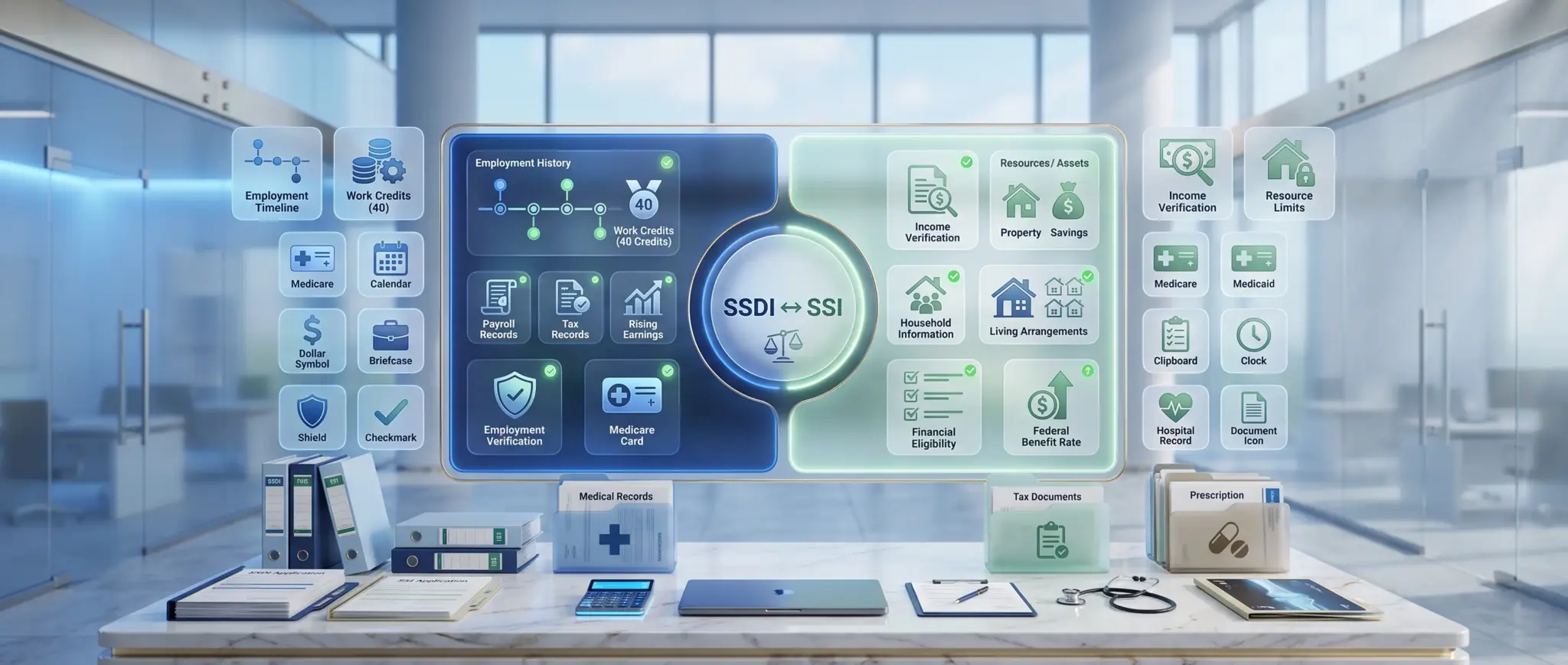
When a serious medical condition disrupts your ability to work, federal disability programs can appear similar from a distance. Social Security Disability Insurance and Supplemental Security Income are both administered by the Social Security Administration, and both may provide monthly payments to eligible people with disabilities. Yet they are built on different financial foundations and apply different nonmedical rules.
Understanding SSDI vs SSI can help you avoid beginning with the wrong assumptions. One program is tied primarily to your employment record and Social Security-covered earnings. The other is a needs-based program for people with limited income and resources. Some individuals may qualify for one program, while others may qualify for both.
This guide explains the difference between SSDI and SSI, compares SSDI and SSI benefits, and outlines the information to review before applying.
What Is SSDI?
Social Security Disability Insurance is an earned insurance benefit. Workers build coverage through Social Security-taxed wages or self-employment income.
Applicants generally need enough total and recent work credits and must meet Social Security’s disability standard. For adults, the condition must generally prevent substantial work and last at least 12 months or be expected to result in death.
The monthly payment is based largely on the worker’s covered earnings record. Savings, a spouse’s income, or household property do not ordinarily determine the amount, although current work and earnings can affect eligibility.
What Is SSI?
Supplemental Security Income is a needs-based program funded through general federal revenues. It may pay eligible adults or children with disabilities who have limited income and resources, as well as certain people age 65 or older.
SSI does not require a qualifying work history. Social Security instead reviews countable income, resources, living arrangements, and certain support from others.
The Core Distinction Between the Programs
The clearest distinction is the basis for eligibility:
| Factor | SSDI | SSI |
| Program basis | Insured status through covered work | Financial need |
| Work credits | Generally required | Not required |
| Income and resource test | No SSI-style asset limit | Strict income and resource rules apply |
| Payment calculation | Based mainly on covered earnings | Based on the federal benefit rate, countable income, and living arrangements |
| Health coverage | Medicare generally follows entitlement rules | Medicaid is commonly linked to SSI, depending on state procedures |
| Who may qualify | Insured workers with qualifying disabilities | Eligible adults or children with disabilities and limited means; also certain people 65 or older |
An individualized review may also consider disability onset, current earnings, household finances, immigration status, and state Medicaid procedures.
Do the Programs Use the Same Disability Standard?
For most adult claims, Social Security applies the same core disability definition to both programs: a medically determinable impairment must prevent substantial gainful activity and meet the duration rule.
Evidence may include medical records, test results, treatment, medication effects, functional limitations, prior duties, and ability to adjust to other work. A diagnosis alone is not enough; the records must show sustained work-related limitations.
The major distinction is therefore often nonmedical. SSDI asks whether the applicant is insured through covered employment. SSI asks whether the applicant meets strict financial requirements. Understanding SSDI vs SSI requires examining both sides of the case.
How Work History Changes the SSDI vs SSI Analysis
Work history is central to SSDI. Social Security reviews total and recent credits and whether the person was insured when disability began. Someone who stopped working years earlier may need to prove onset by the date last insured.
SSI does not use this insured-status test. A person with little or no work history may still be considered if the medical, financial, and other program rules are satisfied.
This can be especially important for younger adults, caregivers, intermittent workers, and people whose recent jobs were not Social Security-covered.
How Income and Resources Are Treated
SSDI generally does not apply SSI’s resource ceiling. Savings and household assets do not normally determine the SSDI payment, although work earnings and certain public disability payments may matter.
SSI counts many forms of income and resources, subject to exclusions. Wages, pensions, cash, bank accounts, and support from others may matter, while certain items—such as a primary residence—may be excluded.
When comparing SSDI and SSI benefits, applicants should distinguish between work-based insured status and needs-based financial eligibility.
Can You Receive Both SSDI and SSI?
Yes. Some people receive concurrent benefits. This can happen when an individual qualifies for SSDI based on work history, but the SSDI payment is low enough that the person also meets SSI’s income and resource rules.
Concurrent eligibility does not mean two full payments are added together. SSI is calculated after countable income, including SSDI, is considered.
Concurrent eligibility can also involve both Medicare and Medicaid under separate rules.
Medicare, Medicaid, and Disability Benefits
People entitled to SSDI generally become eligible for Medicare after the applicable waiting period, with exceptions for certain conditions.
SSI is commonly linked to Medicaid, but state procedures vary. In many states, SSI eligibility leads automatically to Medicaid; in others, a separate Medicaid application or state determination may be required.
A complete SSDI vs SSI review should consider both cash payments and the timing of health coverage.
How Payments Are Determined
SSDI payments reflect covered earnings, so people with similar conditions may receive different amounts.
SSI starts with a federal maximum and is adjusted for countable income and living arrangements; some states add supplements.
This is another practical difference between SSDI and SSI: SSDI is calculated as an insurance benefit, while SSI is designed to bring eligible individuals closer to a basic income-support level.
Which SSDI vs SSI Path Should You Explore?
Consider SSDI first when you have a meaningful recent work history and paid Social Security taxes. Consider SSI when work credits may be limited and your income and resources are low. Explore both when your work-based benefit may be modest and you may also satisfy SSI’s financial rules.
A useful preliminary review should address:
- Age and disability onset date
- Recent and total covered work
- Current earnings
- Medical evidence and functional limits
- Household income and resources
- Living arrangements
- Potential Medicare or Medicaid eligibility
The SSDI Eligibility Checker offers a focused, no-pressure starting point for reviewing work-history and disability factors commonly associated with SSDI. It does not decide a claim, determine SSI eligibility, or guarantee approval; it helps users organize the right questions before applying.
Common Mistakes to Avoid
Assuming a Diagnosis Guarantees Approval
Social Security considers functional limitations, duration, medical support, and the ability to perform substantial work—not merely the name of a condition.
Ignoring the Date Last Insured
For SSDI, proving that disability began while insured can be decisive, particularly after a long absence from work.
Overlooking Financial Changes During an SSI Claim
Income, resources, living arrangements, and support from others may change SSI eligibility or payment amounts.
Treating SSDI vs SSI as an Either-Or Choice
Some applicants should be screened for both programs.
Documents to Gather Before Applying
Prepare a clear record of:
- Identity information
- Medical providers, diagnoses, tests, and treatment dates
- Medications and side effects
- Relevant jobs and duties
- W-2s, tax returns, and self-employment records
- Current earnings and accommodations
- Income, resources, and living arrangements if SSI may apply
- The date the condition began affecting work
Organized records cannot guarantee approval, but they can reduce omissions.
Final Perspective
The correct program depends on work credits, insured status, income, resources, age, living arrangements, and health-coverage needs.
The best way to approach SSDI vs SSI is to separate the questions. First, determine whether your employment record may support SSDI. Second, determine whether your financial circumstances may support SSI. Third, document how the medical condition limits sustained work.
Understanding the difference between SSDI and SSI gives you a clearer framework, while comparing SSDI and SSI benefits helps you evaluate the practical consequences of each program. The Social Security Administration makes the final determination, but informed preparation can make the first step far less confusing.